Category: Uncategorized

  • FBR Digital Invoicing Software

    FBR Digital Invoicing Software

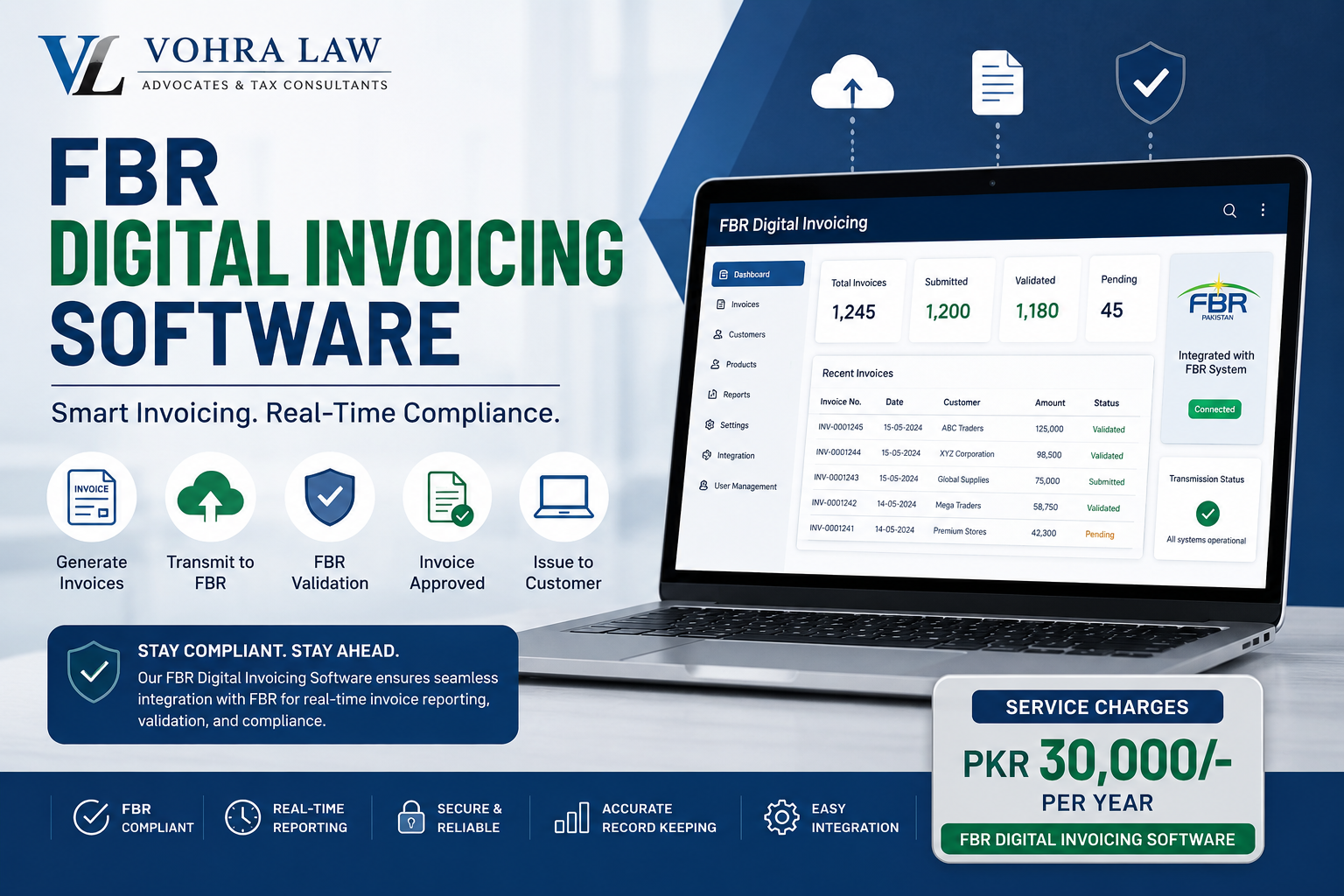
    FBR Digital Invoicing Software Services by Vohra Law

    Businesses in Pakistan are increasingly required to comply with the Federal Board of Revenue’s digital invoicing requirements. To help businesses meet these obligations efficiently, Vohra Law offers FBR Digital Invoicing Software services that enable seamless integration with FBR systems and ensure real-time invoice reporting.

    Our solution is designed for manufacturers, importers, distributors, wholesalers, retailers, and other businesses that are required to issue and report invoices through the FBR digital invoicing framework.


    What is FBR Digital Invoicing?

    FBR Digital Invoicing is a system introduced by the Federal Board of Revenue that requires registered businesses to generate invoices electronically and transmit invoice data to FBR in real time or near real time.

    The objective of the system is to:

    • Improve tax compliance.
    • Reduce tax evasion.
    • Ensure transparency in business transactions.
    • Facilitate documentation of the economy.
    • Enable efficient sales tax monitoring.

    Under this system, invoices generated by businesses are integrated with FBR’s digital platform and are assigned a unique invoice identification number.


    How Does the FBR Digital Invoicing Process Work?

    The digital invoicing process generally involves the following steps:

    1. Invoice Generation

    The business creates a sales invoice through its billing, ERP, POS, or accounting software.

    2. Transmission to FBR

    The invoice details are automatically transmitted to the FBR system through secure API integration.

    3. Validation by FBR

    FBR validates the invoice information and verifies compliance requirements.

    4. Invoice Number Generation

    Upon successful validation, a unique invoice number or reference is generated.

    5. Final Invoice Issuance

    The validated invoice can then be issued to the customer with the required FBR details.

    6. Record Maintenance

    All invoice data remains properly documented and available for audit and compliance purposes.


    Our FBR Digital Invoicing Software Services

    At Vohra Law, we provide complete assistance for businesses seeking FBR digital invoicing compliance.

    Our services include:

    • FBR Digital Invoicing Software setup.
    • API integration with FBR.
    • Configuration of billing systems.
    • POS and ERP integration.
    • Invoice transmission automation.
    • Testing and validation support.
    • Compliance consultation.
    • Ongoing technical support.
    • Annual software maintenance.

    Whether you are a small business or a large enterprise, our team can help implement a reliable and compliant digital invoicing solution.


    Benefits of Using Our FBR Digital Invoicing Software

    Full FBR Compliance

    Ensure compliance with FBR digital invoicing regulations and avoid potential penalties.

    Automated Invoice Reporting

    Invoices are automatically transmitted to FBR without manual intervention.

    Reduced Errors

    Minimize human errors in invoice reporting and documentation.

    Real-Time Validation

    Receive immediate confirmation of invoice registration and validation.

    Better Record Keeping

    Maintain accurate and organized records for tax and audit purposes.

    Easy Integration

    Compatible with existing accounting, POS, and ERP systems.


    Service Charges

    FBR Digital Invoicing Software Package

    Annual Software Subscription Fee:
    PKR 30,000/- Per Year

    The package includes:

    • Software access.
    • FBR integration support.
    • Basic setup assistance.
    • Annual software maintenance.
    • Technical support for compliance-related issues.

    Additional customization, ERP integration, and enterprise-level implementation may be charged separately depending upon business requirements.


    Who Needs FBR Digital Invoicing?

    Our FBR Digital Invoicing Software is suitable for:

    • Manufacturers
    • Importers
    • Distributors
    • Wholesalers
    • Retailers
    • E-commerce businesses
    • Service providers
    • Corporate entities registered for sales tax

    Why Choose Vohra Law?

    Vohra Law combines legal, regulatory, and compliance expertise with practical technology solutions. We help businesses navigate FBR requirements while ensuring smooth implementation of digital invoicing systems.

    Our team provides:

    • Professional compliance guidance.
    • Fast software deployment.
    • Dedicated client support.
    • Affordable annual pricing.
    • Reliable FBR integration assistance.

    Get Started Today

    If your business is required to comply with FBR digital invoicing regulations, Vohra Law can help you implement a complete and cost-effective solution.

    FBR Digital Invoicing Software

    Annual Charges: PKR 30,000/- Only

    Contact Vohra Law today to streamline your invoicing process, ensure FBR compliance, and simplify your tax reporting obligations.

  • How to register a Private limited Company in Pakistan ?

    How to register a Private limited Company in Pakistan ?

    Why Incorporate Through SECP  and What “Company” Means

    When you incorporate with SECP, your business becomes a legal “company” under the Companies Act, 2017. That gives you benefits such as limited liability, separate legal identity, ability to raise capital, easier access to bank accounts, credibility with clients/investors, and easier compliance with regulatory/tax frameworks.

    Under SECP, you can form:

    • A private company (with two or more persons)
    • A “single-member private company” (if only one person)
    • A public company (if three or more persons)

    Thus whether you want a small single-owner startup or a larger venture with multiple shareholders, SECP incorporation works.


    Step-by-Step: How to Incorporate a Company via SECP

    1. Decide Company Type & Prepare Basic Info

    Before you begin, decide the structure private, public, or single-member private company  based on number of promoters/shareholders and how you want to operates

    Also identify who will be the directors/subscribers, the registered office address, authorised share capital (if any), and other basic details.


    2. Name Reservation

    • First you need to propose a company name. SECP allows you to submit up to three proposed names, in order of preference.
    • Use the SECP name-search tool to check whether the name is available, unique (not identical or too similar to existing companies), and doesn’t contain disallowed/misleading/offensive words.
    • You can apply for name reservation either online via SECP’s e-Services portal or offline (physical application at Registrar office)
    • Once name is reserved, you can proceed to incorporation. Often you can combine name reservation and incorporation in a single application.

    3. Register on SECP e-Services Portal (if going online)

    • Go to SECP’s e-Services portal (eservices.secp.gov.pk) and sign up: provide your CNIC / passport / NICOP / POC, email, mobile number, etc.
    • Every proposed subscriber / director should have a separate user account.
    • After login, you can choose “Company registration / incorporation” process from the dashboard.

    4. Prepare Incorporation Documents

    You’ll need to draft/collect the following:

    • Memorandum of Association (MOA): defines the objectives, scope and nature of business.
    • Articles of Association (AOA): outlines governance, management structure, internal rules etc.
    • Declaration of compliance or other statutory forms (depending on company type).
    • Copies of CNIC / passport (or other valid ID) of all subscribers/directors.
    • Proof of registered office address (e.g. utility bill, lease agreement, address verification).
    • Bank deposit certificate or proof for paid-up capital (if required) / initial capital info.

    If you are a foreign subscriber / director / shareholder, additional requirements apply (e.g. undertaking for compliance & return filings).


    5. Submit Incorporation Application Online or Offline

    Online method (via e-Services):

    • After login, choose company incorporation process. Fill in detail: company name, type, selected bank branch for payment, mode of payment.
    • Add “Declarant” a person authorized to represent the company in the application (could be a director or employee).
    • Enter details of directors / subscribers, company information (registered office, business classification, share capital, etc.)
    • Upload attachments: MOA, AOA, ID copies, name reservation approval, any other required docs. Attachment file-size limits may apply (e.g. usually < 2 MB each).
    • Generate bank challan automatically via portal, or choose online payment (credit/debit card, Internet Banking, 1Link banking, etc).
    • Sign the form using your SECP e-Services PIN. Important: each subscriber/director must sign individually with their credentials & PIN.
    • Submit the application. You’ll receive a reference number keep it for tracking. Then print the challan and pay at designated bank (or proceed with online payment).

    Offline (physical) method:

    • Generate “M-Challan” from SECP website for fee payment.
    • Deposit fee at designated bank (like MCB or UBL) in appropriate branch.
    • Submit physical application along with MOA, AOA, forms, documents & original challan copies to the relevant Registrar of Companies (CRO).

    Note: While offline is still allowed, online is now standard especially for faster processing


    6. Pay Fees & Wait for SECP Review

    • Fee depends on authorised capital and type of company. For small companies (e.g. capital up to PKR 100,000) fees are relatively low, but they increase with capital
    • If you need urgent processing, you can apply through Fast Track Registration Services (FTRS)  SECP sometimes completes incorporation within 4 hours.
    • For regular applications, once documents/payment are verified, SECP reviews them for compliance with the law — this can take a few days (depending on load, complexity, completeness).
    • If there are objections or missing info, you’ll get a notice; you should respond promptly to avoid delays.

    7. Certificate of Incorporation & Legal Recognition

    If everything is approved, SECP will issue the official Certificate of Incorporation. This certificate confirms that your company is now legally a registered company under Pakistani law.

    You (and other directors/subscribers) will also receive copies of MOA, AOA and other incorporation documents, often via your e-Services account or via email.

    Once you have this certificate, your company can start operating legally: sign contracts, open a corporate bank account, apply for licences, etc.


    Post-Incorporation: What to Do After Registration

    After your company is incorporated, you must take additional steps to become fully operational and compliant:

    • Register with Federal Board of Revenue (FBR) to obtain a National Tax Number (NTN). This is essential for tax compliance, issuing invoices, and legal business operations.
    • Open a corporate bank account. Banks typically require Certificate of Incorporation, CNICs of directors, address proof, sometimes a board resolution.
    • If your business requires sales tax registration (e.g. for goods or taxable services), register accordingly with relevant tax authority.
    • Maintain corporate compliance: depending on company size, you may need to file annual returns, appoint auditors (if paid-up capital or other thresholds trigger audit requirement), maintain records, and comply with company law.

    These post-incorporation steps are important to avoid legal/tax problems, and to enable smooth business operations.

  • Procedure of POS Software Integration in Pakistan with FBR – A Complete Guide

    Procedure of POS Software Integration in Pakistan with FBR – A Complete Guide

    In recent years, the Federal Board of Revenue (FBR) has taken strong steps toward digitalizing the retail sector in Pakistan. One of the major initiatives is the compulsory integration of POS software with FBR for Tier-1 retailers. This process ensures transparency, real-time sales reporting, and accurate tax collection.

    If you are a business owner—especially in retail—understanding how to integrate your POS software with FBR is essential. This guide explains the complete procedure, requirements, and benefits in simple, clear steps.


    What Is FBR POS Integration?

    FBR POS integration is the process where a retailer’s POS software connects directly with FBR servers. Each sale processed through the POS is reported in real-time to FBR via an electronic invoice system. The purpose is to curb tax evasion, improve documentation, and ensure fair competition among retailers.


    Who Needs to Integrate POS Software With FBR?

    FBR has defined Tier-1 retailers who MUST integrate their POS systems. These include:

    • Retailers operating as franchises or chains
    • Retailers with large retail outlets in shopping malls
    • Retailers with electricity bills above the prescribed limit
    • Wholesalers-cum-retailers
    • Retailers dealing in furniture, electronics, jewelry, and large-scale consumer items

    If your business falls under these categories, integrating your POS software is mandatory.


    Step-by-Step Procedure for POS Software Integration With FBR

    Step 1: NTN & Sales Tax Registration

    Before any integration, the retailer must have:

    • A valid National Tax Number (NTN)
    • Sales Tax Registration (STRN)

    If not already registered, apply through FBR’s IRIS Portal.


    Step 2: Configure POS Software According to FBR Standards

    Your POS software must comply with FBR’s technical requirements:

    • Ability to generate electronically verifiable invoices
    • Real-time communication with FBR’s servers
    • Secure transmission of invoice data
    • Proper user authentication

    Most modern POS systems already come with FBR integration features.


    Step 3: Enroll in FBR Taxpayer Facilitation Portal

    Login to the FBR’s Taxpayer Facilitation Portal (TFA) using your IRIS credentials.

    Here you must:

    • Select “POS Integration”
    • Register your retail outlets
    • Register POS machines and terminals

    This process assigns a unique POS ID to each terminal.


    Step 4: Obtain FBR API Credentials

    To connect your POS software with FBR servers, you must generate:

    • API User ID
    • API Password
    • Integration Keys

    These credentials allow your POS system to send invoice data securely to FBR.


    Step 5: Activate the Software Integration

    Your POS vendor or software team will:

    1. Enter the FBR API credentials into the POS system
    2. Test the connection with FBR’s sandbox environment
    3. Finally, connect the live environment for real-time reporting

    A successful test ensures that every sale-going forward is reported to FBR automatically.


    Step 6: Generate FBR-Compliant Invoices

    Once integrated, your POS software must issue FBR-approved invoices, containing:

    • FBR logo
    • QR code
    • POS ID
    • Taxpayer details
    • Real-time verification link

    These invoices help ensure compliance for both the retailer and the customer.


    Step 7: Confirm Integration Status With FBR

    Login to your TFA portal and check:

    • POS status
    • Invoice reporting history
    • Outlet compliance status

    If everything is connected correctly, your outlet will appear as “Integrated” in FBR’s system.


    Benefits of Using FBR-Integrated POS Software

    Using integrated POS software brings several advantages:

    Avoidance of Heavy Penalties

    Non-compliance may lead to fines and sealing of business premises.

    Accurate and Transparent Sales Reporting

    Ensures authenticity in business records.

    Digital Efficiency

    No manual submission of sales or tax records.

    Better Customer Trust

    FBR-verified invoices build credibility.

    Automation of Tax Calculations

    The system automatically applies and calculates sales tax.


    Conclusion

    Integrating POS software with FBR is no longer optional for Tier-1 retailers—it is a legal requirement and a major step toward digital transparency in Pakistan. The process is simple if handled correctly, and choosing the right POS system will save time, effort, and compliance issues.

    Retailers using modern, FBR-compatible POS software not only avoid penalties but also enhance operational efficiency and customer trust.

    If you need help with FBR registration, POS integration, or tax consultancy contact us,

  • Comprehensive review — Pakistan income-tax slabs (Tax Year 2025 → FY 2025-26)

    Comprehensive review — Pakistan income-tax slabs (Tax Year 2025 → FY 2025-26)

    Below is a clear, sourced, and practical review of the income-tax changes that take effect from 1 July 2025 (Tax Year / Fiscal Year 2025-26). I’ve focused on the salaried-individual slab changes (the main relief announced), key ancillary changes (surcharge, cash-withdrawal tax, company rates), worked examples, and what employers/payroll teams and individuals should do.


    Short summary

    The Finance Act, 2025 reduced incremental tax rates for salaried individuals at lower and middle income brackets while keeping the top marginal rate at 35%. Notable practical changes: the band Rs 600,001–1,200,000 is taxed at 1% (down from 5%), intermediate bands were reduced (e.g., 15% → 11%, 25% → 23%), and the surcharge for very high salaried incomes (> Rs 10,000,000) was reduced from 10% to 9%. These changes are effective 1 July 2025.


    The new slab structure for salaried individuals (Finance Act, 2025)

    (These are incremental rates applied to the portion of annual taxable income falling in each band.)

    • Up to Rs 600,000 —— 0%
    • Exceeding Rs 600,000 up to Rs 1,200,000 —— 1% on the amount exceeding Rs 600,000.
    • Exceeding Rs 1,200,000 up to Rs 2,200,000 —— 11% on the amount exceeding Rs 1,200,000.
    • Exceeding Rs 2,200,000 up to Rs 3,200,000 —— 23% on the amount exceeding Rs 2,200,000.
    • Exceeding Rs 3,200,000 up to Rs 4,100,000 —— 30% on the amount exceeding Rs 3,200,000.
    • Exceeding Rs 4,100,000 —— 35% on the amount exceeding Rs 4,100,000.

    (This table and the wording above follow the Finance Bill/Act and professional tax briefs summarizing the First Schedule changes for salaried taxpayers.)


    Important related changes to note

    • Surcharge for very high salaried incomes: reduced from 10% → 9% for salaried taxpayers whose taxable income exceeds Rs 10,000,000.
    • Cash-withdrawal/advance-tax on cash withdrawals: advance tax on large cash withdrawals was increased (reference in Finance Act / FBR circular — practical payroll/cash management implication).
    • Company and corporate rates / special rates: separate changes (e.g., banking companies, companies, SME regimes) were made in Finance Act 2025 — these differ from personal slabs and are covered by professional memos (

    What this means (practical impact)

    • Lower & middle incomes get meaningful relief: taxpayers with annual incomes just above Rs 600k and up to ~Rs 4.1m see a lower incremental tax burden versus prior year; the biggest percentage cuts are at the low end (e.g., Rs 600k–1.2m). (Illustrative impacts and government commentary appear in budget/supporting materials.)
    • Top marginal rate unchanged (35%): so very high incomes still face the same top marginal tax, though surcharge was trimmed slightly for the highest salaried group.
    • Budget vs revenue tradeoff: the government expects to balance relief with other measures (wider base, other rate increases and measures) — expect continued emphasis on withholding, documentation, and some new digital-payment related taxes.
  • Karachi Chamber of Commerce and Industry Registration

    Karachi Chamber of Commerce and Industry Registration

    KCCI Registration Services in Karachi – Fast, Easy & Hassle-Free | Professional Tax Consultant

    Are you planning to register your business with the Karachi Chamber of Commerce & Industry (KCCI)? Whether you are a new business, a growing company, or an established enterprise looking to expand your credibility, KCCI membership is one of the most valuable steps you can take. As a professional tax consultant, we offer complete KCCI Registration and Renewal Services with end-to-end documentation and expert compliance support.


    What is KCCI and Why You Need It?

    The Karachi Chamber of Commerce & Industry is Pakistan’s largest and most influential chamber, representing thousands of businesses from every industry.

    Having a KCCI membership provides businesses with:

    • Credibility & Recognition
    • Access to Business Networks & Trade Opportunities
    • Support in Local and International Trade
    • Business Visa Recommendation Letters
    • Certificate of Origin for Exports
    • Government Liaison & Policy Support
    • Participation in Exhibitions & Business Delegations

    If you want to grow your business locally or internationally, KCCI registration is essential.


    Our Professional KCCI Registration Services

    We offer a seamless, guided process to help businesses register with the Karachi Chamber without stress or delays. Our services include:

    New KCCI Membership Registration

    We handle complete documentation, processing, and submission on your behalf.

    KCCI Membership Renewal Services

    Annual renewals are mandatory — we assist in fast, error-free renewals.

    Documentation & Compliance Assistance

    From NTN & STRN verification to bank certificates and partnership deeds, we manage everything.

    Business Proof & Verification Support

    We prepare and verify all required business proofs to meet KCCI standards.

    Consultation for Exports, Imports & Trade Certificates

    Including Certificate of Origin and visa recommendation documentation.


    Why Choose Us for KCCI Registration?

    Expert Knowledge of Requirements

    We understand KCCI procedures thoroughly — no mistakes, no delays.

    Fast Processing

    We ensure your membership application is completed and submitted quickly.

    End-to-End Support

    From documents to approvals, we take care of everything.

    Affordable Fees

    Professional service at market-competitive prices.

    Trusted Tax & Business Consultants

    We already assist clients in taxation, NTN, STRN, company registration, and business compliance.


    Documents Required for KCCI Registration

    Depending on business type (sole proprietorship, partnership, company), KCCI may require:

    • NTN Certificate
    • Bank Certificate
    • Business Letterhead
    • Utility Bill of Business Address
    • Partnership Deed / Company Documents (if applicable)
    • CNIC Copies
    • Sales Tax Registration (if applicable)
    • Visiting Card
    • Bank Statement (minimum balance requirements)

    We guide you through the entire list and prepare everything for you.


    How Our KCCI Registration Process Works

    1. Initial Consultation
      We review your business documents and eligibility.
    2. Document Preparation
      We prepare and complete all required forms and proofs.
    3. Submission & Follow-up
      We handle submission and coordinate with KCCI.
    4. Membership Approval
      Once approved, we provide your digital & physical membership documents.

    Simple, fast, and worry-free.


    Who Should Apply for KCCI Membership?

    • Traders & wholesalers
    • Retail businesses
    • Importers & exporters
    • Manufacturers
    • Online businesses
    • Startups & SMEs
    • Service Providers

    If you want to expand your business, increase credibility, and participate in trade opportunities — KCCI membership is for you.

    Charges:Rs 15000/ for new Registration


    Need Help with KCCI Registration? Contact Us Today

    We provide professional, reliable and quick KCCI registration and renewal services for all business types.
    Let us handle the paperwork while you focus on growing your business.

    📞 Call / WhatsApp: 0323-8201970
    📧 Email: vohralawassociates7@gmail.com

  • Responding to FBR Notices in Pakistan: A Complete Guide

    Responding to FBR Notices in Pakistan: A Complete Guide

    Receiving a notice from the Federal Board of Revenue (FBR) in Pakistan can be intimidating, whether it’s for income tax, sales tax, or any other compliance matter. However, with the right approach, you can respond effectively and avoid penalties. This guide explains how to handle FBR notices, step by step.


    What is an FBR Notice?

    An FBR notice is an official communication sent to taxpayers when the FBR requires clarification regarding their tax filings, discrepancies in returns, or compliance issues. Common reasons include:

    • Mismatched income or expense declarations
    • Missing or incomplete tax filings
    • Non-payment of due taxes
    • Verification of financial statements or records

    Ignoring an FBR notice can lead to fines, legal consequences, or even audits. So timely and proper response is crucial.


    Types of FBR Notices

    FBR sends different types of notices depending on the issue:

    1. Income Tax Notices – For personal or business income discrepancies.
    2. Sales Tax Notices – For issues related to VAT or GST filings.
    3. Withholding Tax Notices – Related to taxes deducted at source.
    4. Audit or Verification Notices – When FBR wants to review your financial statements.

    Each notice has a deadline for response, which must be respected to avoid penalties.


    Steps to Respond to an FBR Notice

    Here’s a step-by-step approach to handling FBR notices:

    1. Read the Notice Carefully

    Check all details including:

    • Type of notice
    • Tax period in question
    • Deadline for response
    • Specific information or documents requested

    Understanding the notice is key to responding correctly.

    2. Gather Required Documents

    Prepare all supporting documents such as:

    • Bank statements
    • Sale/purchase invoices
    • Tax returns
    • Audit reports

    3. Verify Your Records

    Cross-check your records with the information mentioned in the FBR notice. Identify any discrepancies and clarify them before responding.

    4. Draft Your Response

    Your response should be:

    • Clear and concise
    • Supported with proper documentation
    • Address all points mentioned in the notice

    5. Submit Your Response

    Responses can be submitted:

    • Online: Through FBR’s IRIS portal
    • Offline: By visiting the relevant FBR office

    Always keep proof of submission.

    6. Follow Up

    After submission, monitor the status of your response. FBR may request additional clarification or issue a closure notice.


    Tips for Handling FBR Notices

    • Respond on time: Avoid penalties by submitting within the deadline.
    • Maintain proper records: Accurate bookkeeping makes responses easier.
    • Consult a tax expert: If the notice is complex, professional help can prevent mistakes.
    • Stay calm and professional: Treat the process as a legal compliance matter, not a personal attack.

    Consequences of Ignoring FBR Notices

    Failure to respond can lead to:

    • Penalties and fines
    • Audit or investigation of your accounts
    • Legal action in severe cases
    • Suspension of business operations or NTN

    Timely and correct response is the best defense.


    Conclusion

    Responding to FBR notices in Pakistan doesn’t have to be stressful. By understanding the notice, gathering proper documentation, and responding professionally, you can resolve most issues smoothly. Maintaining tax compliance and keeping accurate records is the best strategy to avoid future notices.

  • Types of Filers in Pakistan and Their Merits & Demerits

    Types of Filers in Pakistan and Their Merits & Demerits

    Becoming a tax filer in Pakistan offers several financial and legal benefits — but many people don’t know that there are different types of filers, and each category comes with its own advantages and limitations.

    In this guide, we explain the types of filers in Pakistan, how they differ, and the merits and demerits of each so you can choose the right filing status.


    What Is a “Filer” in Pakistan?

    A filer is a person or business listed in the FBR’s Active Taxpayer List (ATL) after submitting their annual income tax return.
    Filer status significantly impacts your:

    • Tax rates
    • Withholding deductions
    • Ability to register a company
    • Business opportunities
    • Legal compliance

    Types of Filers in Pakistan

    Pakistan primarily has three categories of filers:

    1. Individual Filer
    2. AOP (Association of Persons) Filer
    3. Company Filer

    Below is a detailed breakdown of each category along with their merits and demerits.


    🧍‍♂️ 1. Individual Filer (Salary, Business, Freelancer, Property Owner)

    Who qualifies?

    Any individual earning income from:

    • Salary
    • Business
    • Freelancing/Online earnings
    • Rental income
    • Capital gains
    • Investments
    • Agriculture income (in some cases)

    Merits (Advantages)

    • Lower withholding tax on banking, vehicles, property transactions.
    • Eligibility to purchase, sell, and transfer property smoothly.
    • Ability to register NTN and open a business legally.
    • Access to government tenders or contracts requiring filer status.
    • Strong financial credibility for visa, loan, credit card applications.
    • Can register with SECP, open company bank accounts, or act as a director.

    Demerits (Disadvantages)

    • Must file annual income tax return and wealth statement.
    • Late filing results in penalties and loss of ATL status.
    • Salaried individuals often need documentation from employers.
    • Requires record-keeping of income, expenses, and assets.

    👥 2. AOP Filer (Partnership Firms)

    Who qualifies?

    Any business registered as:

    • Partnership
    • Firm
    • Local business entity run by two or more partners

    Merits (Advantages)

    • Lower withholding taxes compared to non-filers.
    • Ability to register the partnership with FBR and banks.
    • More tax-saving opportunities through expense deductions.
    • Can hire employees, sign corporate contracts, and register for sales tax.
    • Suitable for family businesses or shared ownership companies.

    Demerits (Disadvantages)

    • Requires monthly sales tax filing if registered for STRN.
    • Annual return filing + withholding statements may be required.
    • Partners must file their individual tax returns as well.
    • Complex documentation compared to individual filers.

    🏢 3. Company Filer (Private Limited, Single Member, Public Limited)

    Who qualifies?

    Any company registered with SECP such as:

    • Private Limited Company
    • Single Member Company
    • Public Company
    • Non-profit companies

    Merits (Advantages)

    • Strongest legal and financial credibility.
    • Can participate in major tenders, corporate contracts, and exports.
    • Lower tax penalties and withholding than non-filers.
    • Can claim maximum expense deductions for tax saving.
    • Easier access to business loans, corporate accounts, and investment.
    • Required for working with international clients and marketplaces.

    Demerits (Disadvantages)

    • Strict compliance requirements (audit, annual filings, sales tax).
    • Requires maintaining proper bookkeeping & financial statements.
    • Penalties for late filing are higher than individuals.
    • Requires annual returns to SECP + tax filings to FBR.

    Filer vs Non-Filer – Why It Matters

    FeatureFilerNon-Filer
    Withholding TaxLowHigh
      Bank TransactionsLow deductionVery high deduction
      Property Purchase/SaleAllowed smoothlyHeavy taxes
      Vehicle RegistrationCheaperHigher token taxes
      Business OpportunitiesManyLimited
        Loans / Financial CredibilityStrongWeak

    Being a filer gives you legal protection, tax savings, and better business opportunities.


    Conclusion

    Every person or business in Pakistan should understand the types of filers and choose the category that matches their income and operations.
    Whether you’re a salaried individual, business owner, partner, or company director — being a filer gives you long-term benefits and financial security

  • Top Benefits of Sales Tax Filing in Pakistan

    Top Benefits of Sales Tax Filing in Pakistan

    Sales tax filing is a legal requirement for many businesses in Pakistan — especially retailers, wholesalers, service providers, and companies registered with FBR or provincial revenue authorities like SRB, PRA, KPRA, and BRA. But beyond legal compliance, sales tax filing brings several financial, operational, and business-growth advantages.

    In this article, we break down the key benefits of filing sales tax returns in Pakistan, and why every registered business must stay compliant.


    1. Legal Compliance with FBR and Provincial Tax Authorities

    The most important benefit of sales tax filing is legal compliance.
    Businesses registered under STRN (Sales Tax Registration Number) must file monthly sales tax returns.

    Being compliant helps you:

    • Avoid penalties
    • Avoid notices from FBR/SRB
    • Maintain clean business records
    • Operate legally without disruptions

    Non-compliance can result in heavy fines, audits, and even suspension of your STRN.


    2. Avoiding Heavy Penalties and Fines

    Missing or late sales tax filing can lead to:

    • Daily penalties
    • Additional tax
    • Suspensions
    • Audits
    • Blacklisting

    Regular and timely filing protects your business from these costly consequences.


    3. Claiming Input Tax Adjustments

    One of the biggest benefits of filing sales tax is the ability to claim input tax.

    This means you can deduct the sales tax you paid on:

    • Purchases
    • Imports
    • Raw materials
    • Operating expenses

    When done correctly, this significantly reduces your tax liability, saving you money every month.


    4. Better Business Reputation

    Companies that file sales tax regularly are seen as:

    • More credible
    • More professional
    • More trustworthy

    This is especially important when working with:

    • Corporate clients
    • Government agencies
    • Banks
    • International suppliers
    • Large retail networks

    Many businesses refuse to work with non-compliant or unregistered entities.


    5. Required for Government & Corporate Contracts

    If you want to participate in:

    • Tenders
    • Government contracts
    • Corporate projects
    • Large supply chains

    you must have active sales tax filing status.

    Businesses that fail to file monthly returns often lose opportunities worth millions.


    6. Supports Business Audit & Transparency

    Sales tax filing requires proper:

    • Sales records
    • Purchase records
    • Bank reconciliation
    • Inventory management

    This improves your internal financial system.

    A transparent and organized business:

    • Makes better decisions
    • Avoids unnecessary losses
    • Attracts investors and lenders
    • Performs better in audits

    7. Access to Refunds and Adjustments

    Many businesses qualify for sales tax refunds, especially exporters.

    Filing monthly sales tax returns enables you to:

    • Claim export-related refunds
    • Adjust prior month taxes
    • Recover excess input tax

    This adds to your cash flow and reduces operational costs.


    8. Mandatory for Importers and Exporters

    If your business imports goods, customs clearance requires:

    • STRN
    • Monthly sales tax compliance

    Similarly, exporters benefit from:

    • Zero-rated sales tax
    • Refund claims
    • Lower tax liabilities

    Regular filing ensures smooth import/export operations.


    9. Helps Keep You in Active Taxpayer Status

    Regular sales tax filing keeps your business active in:

    • FBR Active Taxpayer List (ATL)
    • SRB Active Taxpayer List

    This makes your business eligible for:

    • Lower withholding taxes
    • Faster processing of refunds
    • Better compliance status

    Conclusion: Sales Tax Filing Strengthens Your Business

    Sales tax filing in Pakistan is more than just a legal requirement  it brings major financial, operational, and strategic benefits. From claiming input tax to protecting your business reputation, regular filing helps you stay competitive and compliant.

    If your business is registered for sales tax, filing returns every month is essential.

  • Top Benefits of NTN Registration in Pakistan

    Top Benefits of NTN Registration in Pakistan

    If you want to grow your business, protect your income, or become an active taxpayer, the first step is getting your NTN Registration in Pakistan. Your National Tax Number (NTN) is your official identity with the Federal Board of Revenue (FBR). Without an NTN, you cannot file taxes, and you miss out on several financial benefits.

    In this SEO-friendly article, you’ll learn the major benefits of NTN registration and why every salaried person, business owner, freelancer, or property holder in Pakistan should get their NTN today.


    1. NTN Is Required to Become a Tax Filer

    You cannot become a tax filer without NTN registration.
    Once you have an NTN, you can file your income tax return and get your name added to the Active Taxpayers List (ATL).

    Being a filer helps you save money, avoid penalties, and enjoy lower tax rates.


    2. Lower Taxes on Banking, Property & Vehicles

    With an NTN, you can file your tax return and become a filer — and filers pay significantly lower tax rates than non-filers.

    You save money on:

    • Banking transactions
    • Cash withdrawals
    • Vehicle registration & token tax
    • Property purchase/sale
    • Dividends & profit on investments
    • Imports and commercial activities

    NTN registration leads directly to long-term tax savings.


    3. Required for Opening a Business Bank Account

    Banks require NTN for:

    • Opening a business bank account
    • Maintaining company accounts
    • Handling commercial transactions

    If you run a business, having an NTN is mandatory for banking compliance in Pakistan.


    4. Essential for Business Registration & Freelancing

    If you are a freelancer, sole proprietor, or small business owner, you need an NTN to:

    • Register your business
    • Apply for sales tax registration
    • Work with agencies and marketplaces
    • Receive international payments (Payoneer, Upwork, Fiverr)

    NTN gives your business a legal identity.


    5. Protects You from FBR Penalties

    Individuals without an NTN:

    • Face higher tax deductions
    • Risk receiving FBR notices
    • Have no tax compliance record

    Registering for NTN keeps you secure and legally protected.


    6. Required for Import/Export Business

    If you want to start an import or export business in Pakistan, NTN registration is mandatory for:

    • Customs documentation
    • Filing import/export returns
    • Clearing goods at the port

    Without NTN, your business cannot operate legally in international trade.


    7. Better Financial Credibility

    NTN registration improves your financial profile.
    It helps you when applying for:

    • Bank loans
    • Business financing
    • Credit cards
    • Visa applications
    • Leasing & investment accounts

    It shows you are responsible and tax-compliant.


    8. Needed for Property Transactions

    If you want to buy or sell property in Pakistan, most real estate authorities require your NTN.
    It helps you:

    • Pay lower taxes on property transactions
    • Transfer property easily
    • Avoid extra non-filer taxes

    Property owners strongly benefit from having an NTN.


    Conclusion: NTN Registration Is Essential for Everyone in Pakistan

    Whether you’re a salaried employee, business owner, freelancer, or investor, NTN registration opens the door to tax savings, legal protection, business growth, and financial credibility

  • How to Become a Tax Filer in Pakistan – Complete Guide (2025 Update)

    How to Become a Tax Filer in Pakistan – Complete Guide (2025 Update)

    Looking for an easy guide on how to become a tax filer in Pakistan? This -friendly article explains everything you need to know step by step.

    Becoming a tax filer in Pakistan is essential for anyone who wants to save money, avoid penalties, and enjoy the benefits offered by FBR. Whether you are a salaried person, freelancer, business owner, property investor, or e-commerce seller, this guide will help you understand exactly how to register as a tax filer in Pakistan.


    What Is a Tax Filer in Pakistan?

    A Tax filer is a person or business whose name appears in the FBR Active Taxpayers List (ATL).
    To become a filer, you must:

    1. File your Income Tax Return, and
    2. Submit your Wealth Statement.

    Once done, FBR automatically adds you to the ATL.


    Why You Should Become a Tax Filer in Pakistan

    Here are the top benefits of being a filer:

    Lower Taxes

    Filing puts you in the reduced tax bracket for:

    • Banking transactions
    • Vehicle token tax
    • Property purchase & sales
    • Cash withdrawals
    • Imports & exports
    • Dividends & profit on investments

    Avoid Penalties & FBR Notices

    Non-filers face stricter tax laws and higher penalties.

    Better Financial Credibility

    Banks and institutions prefer dealing with tax filers.

    Legal Protection & Compliance

    Filing protects you from legal issues and ensures transparent income reporting.


    How to Become a Tax Filer in Pakistan (Step-by-Step  Guide)

    Step 1: Get Your NTN (National Tax Number)

    If you have a CNIC, you can easily get your NTN through FBR’s IRIS portal.
    You will need:

    • CNIC
    • Mobile number
    • Email address
    • Proof of address
    • Business details (if applicable)

    Step 2: Log In to FBR’s IRIS Portal

    Go to iris.fbr.gov.pk and log in using the credentials sent to your mobile and email.


    Step 3: Complete Your Taxpayer Profile

    Update your basic information such as:

    • Address
    • Employer details (for salaried individuals)
    • Business activity (for freelancers/business owners)
    • Contact information

    A complete profile is required before filing your return.


    Step 4: Prepare Your Income Tax Return

    Your return must include all income sources:

    • Salary income
    • Business/professional income
    • Rent income
    • Property sale/purchase
    • Foreign income
    • Capital gains
    • Investments

    Make sure all information is accurate.


    Step 5: Prepare Your Wealth Statement

    This is the most critical part of becoming a tax filer.
    Your wealth statement includes:

    • Assets (car, house, business capital, cash, etc.)
    • Liabilities (loans, credit card balances)
    • Yearly changes in assets

    Without submitting your wealth statement, you cannot become a filer.


    Step 6: Submit Your Income Tax Return & Wealth Statement

    Once everything is complete:

    • Review your entries
    • Submit your tax return
    • Submit your wealth statement

    After successful submission, you are now considered a tax filer.


    Step 7: Check Your Name in the FBR Active Taxpayers List (ATL)

    Visit the FBR ATL page and search using your CNIC/NTN.
    If your name appears, congratulations! You’re an official FBR Tax Filer in Pakistan.


    Frequently Asked Questions About Tax Filing in Pakistan

    Who must file a tax return in Pakistan?

    • Salaried individuals
    • Freelancers & online earners
    • Business owners
    • Property holders
    • Vehicle owners
    • Anyone who wants to avoid higher taxes

    Can students become tax filers?

    Yes, if they have assets or income in their name.

    What is the deadline for filing tax returns?

    Generally 30th September every year (subject to extensions).


    Final Thoughts: Becoming a Tax Filer Is Simple and Beneficial

    If you want lower taxes, financial credibility, and legal compliance, becoming a tax filer in Pakistan should be your top priority. With a valid NTN, a completed tax profile, and a filed tax return plus wealth statement, you can easily enter the Active Taxpayers List (ATL)